Choosing between an NTC thermistor and an RTD Temperature Sensor is an important decision for equipment manufacturers, engineers, and industrial buyers. Both technologies measure temperature through changes in electrical resistance, but they differ in sensing materials, temperature ranges, accuracy characteristics, response behavior, and integration requirements.
For B2B buyers sourcing temperature sensors in bulk, understanding these differences helps reduce design risks, improve measurement reliability, and select a solution that matches the requirements of the end application. This guide compares NTC thermistors and RTD sensors from a technical and procurement perspective.
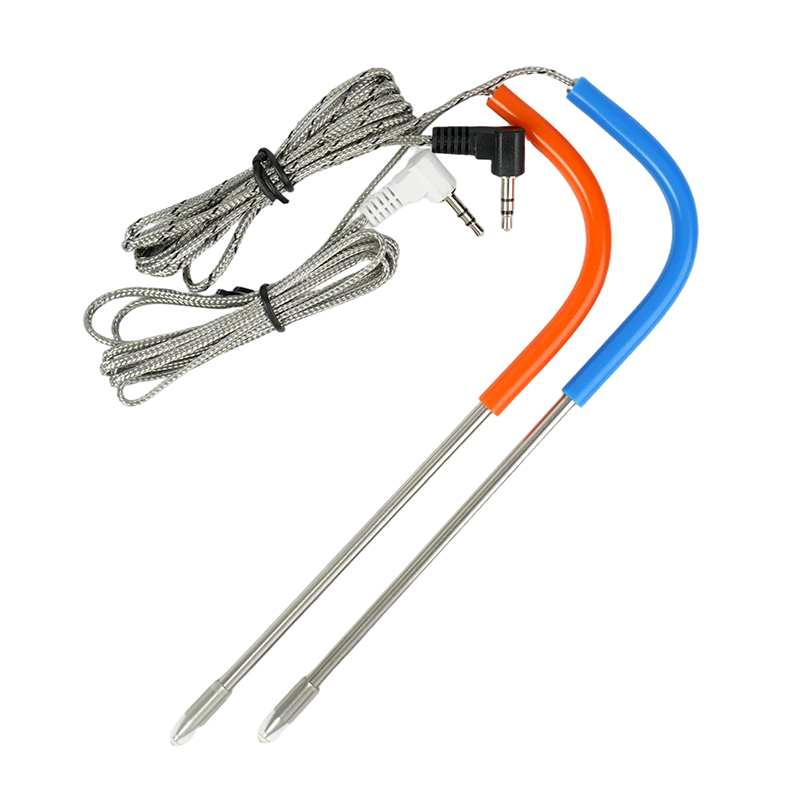
1. What Is an NTC Thermistor?
An NTC thermistor is a temperature-sensitive resistor with a negative temperature coefficient. Its electrical resistance decreases as temperature increases. NTC thermistors are commonly manufactured from semiconductor metal oxide materials and are widely used in applications requiring temperature monitoring, control, and compensation.
Due to their high sensitivity over a defined temperature range, NTC Temperature Sensors are frequently integrated into household appliances, HVAC systems, battery management systems, automotive electronics, medical equipment, and industrial control devices.
Key Characteristics of NTC Thermistors
High sensitivity: Resistance changes significantly with temperature, supporting precise temperature detection within the designed operating range.
Compact construction: Available in bead, disc, probe, chip, and other customized configurations.
Cost-effective production: Suitable for many high-volume applications where cost and space efficiency are important.
Nonlinear resistance response: Typically requires calibration or linearization in the measurement circuit.
Application-specific temperature range: Operating limits depend on the sensing element, encapsulation, probe construction, and installation environment.
2. What Is an rtd temperature sensor?
An RTD, or resistance temperature detector, measures temperature by detecting changes in the electrical resistance of a metal sensing element. Platinum is widely used because of its stable and repeatable resistance-temperature relationship. Common configurations include Pt100 and Pt1000 sensors.
An RTD temperature sensor is often selected for industrial process monitoring, laboratory equipment, manufacturing systems, and applications where measurement stability and repeatability are important. Depending on the design, RTDs can be supplied with two-wire, three-wire, or four-wire connections to meet different measurement requirements.
Key Characteristics of RTD Sensors
Stable measurement performance: Platinum RTDs are widely used where long-term stability and repeatability are required.
Good measurement accuracy: Performance depends on the sensor tolerance class, instrumentation, wiring, and calibration.
Predictable resistance-temperature relationship: Supports reliable temperature measurement and system calibration.
Multiple wiring configurations: Two-wire, three-wire, and four-wire designs help accommodate different installation and lead-resistance compensation requirements.
Flexible industrial integration: Available in probe, surface, and other configurations depending on the application.
3. NTC vs. RTD: Main Differences
Although both technologies use resistance changes to measure temperature, their performance characteristics and application suitability differ. The following table provides a practical comparison for temperature sensor selection.
| Comparison Factor | NTC Thermistor | RTD Sensor |
|---|---|---|
| Sensing material | Semiconductor metal oxides | Typically platinum or another resistance-based metal element |
| Resistance response | Resistance decreases as temperature rises | For a typical platinum RTD, resistance increases as temperature rises |
| Sensitivity | Generally high over its designed temperature range | Generally lower resistance change per degree than an NTC thermistor |
| Linearity | Nonlinear | More predictable and comparatively linear over a specified range |
| Measurement stability | Depends on material, design, and operating conditions | Platinum RTDs are widely used for stable, repeatable measurements |
| Cost considerations | Often economical for high-volume applications | Cost varies with element type, tolerance, probe design, and wiring |
| Common applications | Appliances, electronics, battery systems, HVAC | Industrial processes, laboratory instruments, precision monitoring |
These are general tendencies rather than absolute rules. Actual performance depends on the sensor specification, measurement circuit, installation method, calibration, and operating environment.
4. Which Is More Accurate: NTC or RTD?
Neither technology is automatically more accurate in every application. A properly specified NTC thermistor can provide excellent accuracy within a limited temperature range, particularly when the measurement circuit and calibration are designed for that range.
RTDs, especially platinum Pt100 and Pt1000 sensors, are commonly selected for applications requiring stable, repeatable measurements across a defined temperature range. Their performance is affected by tolerance class, wiring configuration, lead resistance, instrument quality, and calibration.
When evaluating high-accuracy temperature sensors, buyers should compare the complete measurement system rather than the sensing element alone. Important factors include:
Specified accuracy or tolerance across the required temperature range.
Long-term drift and repeatability requirements.
Calibration method and traceability requirements.
Measurement resolution and signal-conditioning capability.
Installation conditions, thermal contact, and potential self-heating.
5. How to Choose Between NTC and RTD for Your Application
For manufacturers and procurement teams, sensor selection should begin with the operating requirements of the finished product. Consider the following factors before requesting a quotation or placing a bulk order.
Operating Temperature Range
Confirm the minimum and maximum operating temperatures, including possible temperature spikes. NTC thermistors are suitable for many applications within a defined range, while RTDs are often used for broader industrial measurement requirements. The actual usable range depends on the complete sensor assembly and its specifications.
Accuracy and Stability Requirements
Define the acceptable measurement error and the expected service life. For applications that require consistent readings over time, evaluate tolerance, drift, calibration, and measurement electronics together.
Response Time and Installation
Response time depends on the sensing element, probe dimensions, protective housing, thermal contact, and surrounding medium. A small NTC element may respond quickly in a suitable design, but an RTD can also provide a fast response when appropriately constructed. Compare response-time specifications under relevant test conditions.
Total Cost and Production Volume
For high-volume electronic products, NTC thermistors may offer an attractive balance of sensitivity and unit cost. RTDs may be a better fit when stability, calibration requirements, or industrial measurement standards are priorities. Buyers should evaluate the total cost, including signal conditioning, installation, calibration, and maintenance.
Customization and Supply Consistency
For OEM projects, confirm whether the manufacturer can provide the required resistance value, tolerance, probe dimensions, cable length, connector, housing material, and operating range. Consistent specifications, quality control, and reliable batch-to-batch performance are important for repeat production.
6. NTC vs. RTD: Which Is Better for B2B Buyers?
The right choice depends on the product design and the priorities of the purchasing team.
Choose an NTC thermistor when high sensitivity within a defined temperature range, compact size, and cost-efficient production are key requirements.
Consider an RTD temperature sensor when measurement stability, repeatability, and well-defined industrial temperature measurement performance are priorities.
Request a customized sensor solution when standard products do not meet your requirements for dimensions, wiring, packaging, tolerance, or installation.
Before finalizing a supplier, ask for the relevant datasheet, resistance-temperature characteristics, tolerance information, operating limits, inspection standards, and samples for verification. For ongoing production, also confirm manufacturing capacity, quality-control procedures, lead times, and the ability to maintain consistent specifications across batches.
7. Frequently Asked Questions
Q1: What is the main difference between NTC and RTD?
The main difference is the sensing material and resistance-temperature behavior. An NTC thermistor uses semiconductor materials and decreases in resistance as temperature rises. A typical platinum RTD increases in resistance as temperature rises and is widely used for stable, repeatable temperature measurement.
Q2: Is an NTC thermistor more sensitive than an RTD?
Generally, an NTC thermistor has a larger relative resistance change per degree over its designed operating range. However, overall measurement performance also depends on the circuit, calibration, and sensor specifications.
Q3: Is Pt100 an NTC thermistor?
No. Pt100 is a platinum RTD with a nominal resistance of 100 ohms at 0°C. Its resistance generally increases as temperature rises, whereas an NTC thermistor's resistance decreases as temperature rises.
Q4: Which temperature sensor is more suitable for industrial applications?
RTDs are commonly used in industrial applications that prioritize stable and repeatable measurements. NTC thermistors are also suitable for many industrial systems, especially when the required temperature range and sensitivity match their specifications. Selection should be based on actual operating conditions.
Q5: Can NTC and RTD sensors be customized for OEM projects?
Yes. Depending on the manufacturer's capabilities, customization may include sensing range, resistance value, tolerance, probe dimensions, cable length, connector, housing, and mounting method. Buyers should provide the application requirements and request technical confirmation before mass production.
Source Temperature Sensors for Your Project
Selecting the right temperature sensor involves more than comparing NTC and RTD technologies. Resistance characteristics, accuracy requirements, installation conditions, product dimensions, and production consistency all influence the final decision.
If your project requires NTC thermistors, RTD sensors, or customized temperature sensing components, share your operating temperature range, accuracy requirements, installation details, and expected order volume to help identify a suitable solution.
Looking for a reliable temperature sensor supplier?
Discuss your technical specifications and OEM requirements with the team.
Contact Us