



A pt100 temperature sensor is a type of platinum resistance temperature detector (RTD) widely used for accurate temperature measurement in industrial automation, process control, HVAC systems, laboratory equipment, and other applications. The basic principle is simple: the electrical resistance of platinum changes predictably as temperature changes, allowing a measuring instrument to determine temperature from the measured resistance.
The name PT100 also describes the sensor itself. "Pt" refers to platinum, while "100" indicates its nominal resistance of 100 Ω at 0°C. Under the IEC 60751 characteristic, the resistance increases as temperature rises.
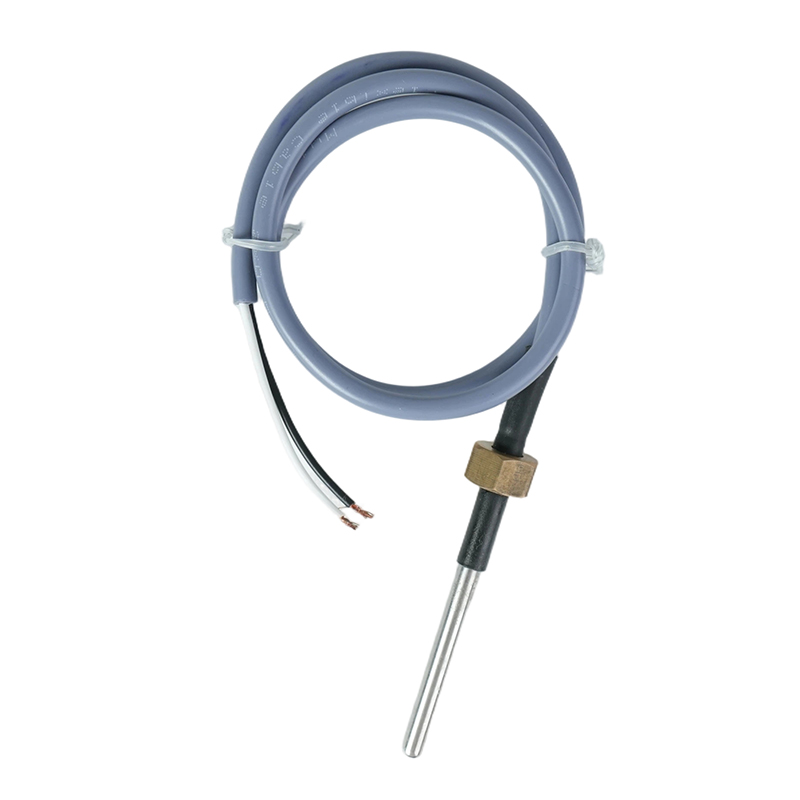
What Is a PT100 temperature sensor?
A PT100 is a platinum resistance thermometer designed to measure temperature by monitoring changes in electrical resistance. The sensing element is typically manufactured as a platinum thin film or platinum wire-wound element and installed inside a protective probe or sheath.
Unlike a thermocouple, which produces a small thermoelectric voltage, a PT100 RTD requires an electrical measurement circuit to determine the resistance of its platinum sensing element.
The nominal resistance of a standard PT100 is 100.00 Ω at 0°C. According to the IEC 60751 characteristic, it is approximately 107.79 Ω at 20°C and 138.51 Ω at 100°C.
How Does a PT100 Work?
The working principle of a PT100 temperature sensor is based on the relationship between temperature and the electrical resistance of platinum.
When the temperature surrounding the platinum sensing element changes, the resistance of the platinum changes in a predictable way. The measurement circuit detects this resistance and converts it into a temperature value using the standardized resistance-temperature relationship.
In simple terms, the measurement process can be understood as:
The temperature surrounding the PT100 sensing element changes.
The electrical resistance of the platinum changes.
The measuring circuit measures the resistance.
The instrument compares the measured resistance with the PT100 characteristic.
The resistance value is converted into a temperature reading.
This predictable relationship between platinum resistance and temperature is the foundation of the PT100 working principle.
Why Does PT100 Resistance Change With Temperature?
Platinum is used in RTDs because its electrical resistance changes in a stable and repeatable manner with temperature. As temperature increases, the resistance of a standard PT100 also increases.
This positive temperature coefficient makes PT100 sensors relatively straightforward to measure and provides a useful relationship between resistance and temperature.
Over the standard industrial range, the resistance-temperature relationship is defined by IEC 60751. For temperatures from 0°C to 850°C, the standard uses a defined mathematical relationship between resistance and temperature rather than assuming a perfectly linear response.
PT100 Resistance and Temperature Relationship
A standard PT100 has a nominal resistance of 100 Ω at 0°C. Its resistance increases as temperature rises and decreases as temperature falls.
| Temperature | Approx. PT100 Resistance |
|---|---|
| -50°C | 80.31 Ω |
| 0°C | 100.00 Ω |
| 20°C | 107.79 Ω |
| 25°C | 109.73 Ω |
| 50°C | 119.40 Ω |
| 100°C | 138.51 Ω |
| 200°C | 175.86 Ω |
These values are based on the standard IEC 60751 characteristic for a nominal 100 Ω platinum RTD.
How Does a PT100 Measure Temperature?
A PT100 itself does not directly display temperature. Instead, a measurement device determines the resistance of the sensing element and converts that resistance into temperature.
A small electrical excitation current can be passed through the RTD. The resulting voltage can then be measured to determine the resistance using the relationship between voltage, current, and resistance.
The measuring instrument then uses the PT100 resistance-temperature characteristic to calculate the corresponding temperature.
Because the resistance changes relatively gradually with temperature, accurate measurement of the resistance is important. The wiring configuration, lead resistance, excitation current, sensor tolerance, and measuring electronics can all affect the final result.
What Are 2-Wire, 3-Wire, and 4-Wire PT100 Sensors?
PT100 sensors are commonly available in 2-wire, 3-wire, and 4-wire configurations. The main difference is how the measurement system handles the resistance of the connecting wires.
2-Wire PT100
A 2-wire PT100 has two wires connected to the sensing element. It is the simplest configuration, but the resistance of the connecting wires is included in the measurement.
For short connections, this additional resistance may be acceptable. For longer cables or applications requiring higher accuracy, lead resistance can introduce a noticeable measurement error.
3-Wire PT100
The 3-wire configuration is widely used in industrial temperature measurement. It is designed to compensate for much of the resistance introduced by the connecting wires when the lead characteristics are suitably matched.
This provides a practical balance between wiring complexity, cost, and measurement accuracy.
4-Wire PT100
A 4-wire PT100 is commonly used when higher measurement accuracy is required. The measurement arrangement separates the current-carrying connections from the voltage-sensing connections, allowing the measurement system to compensate much more effectively for lead resistance.
As a result, 4-wire RTD measurement is often preferred in precision measurement and laboratory applications.
What Is the Difference Between PT100 and PT1000?
Both PT100 and PT1000 are platinum RTD sensors and operate according to the same basic resistance-temperature principle. The main difference is their nominal resistance at 0°C.
| Feature | PT100 | PT1000 |
|---|---|---|
| Material | Platinum | Platinum |
| Resistance at 0°C | 100 Ω | 1000 Ω |
| Basic Principle | Resistance changes with temperature | Resistance changes with temperature |
| Typical Application | Industrial temperature measurement | Industrial and precision applications |
Because the nominal resistance of a PT1000 is ten times that of a PT100, the effect of a given amount of lead resistance can be relatively smaller when expressed as a percentage of the sensor resistance.
Advantages of PT100 Temperature Sensors
PT100 sensors are widely used because platinum provides a stable and well-characterized resistance-temperature relationship.
High Measurement Accuracy
With an appropriate sensor class, wiring configuration, and measurement system, PT100 RTDs can provide accurate temperature measurement for many industrial applications.
Good Long-Term Stability
Platinum sensing elements offer good stability and repeatability, making them suitable for applications where consistent temperature measurement is important.
Wide Temperature Range
Standardized platinum RTD characteristics cover a broad temperature range. IEC 60751 defines the nominal characteristic from approximately -200°C to 850°C, although the actual usable range depends on the sensor construction and application.
Predictable Resistance Change
Because the relationship between resistance and temperature is standardized, measuring equipment can convert resistance into temperature using established characteristic data.
Where Are PT100 Sensors Used?
Because of their accuracy, stability, and predictable characteristics, PT100 temperature sensors are used across many industries.
Industrial automation
Process control
HVAC systems
Heating equipment
Food processing equipment
Laboratory instruments
Manufacturing machinery
Energy systems
Temperature monitoring systems
Industrial control cabinets
PT100 vs. Thermocouple
PT100 RTDs and thermocouples are both widely used for temperature measurement, but they work differently.
| Feature | PT100 | Thermocouple |
|---|---|---|
| Measurement Principle | Resistance change | Thermoelectric voltage |
| Sensing Material | Platinum | Different metal combinations |
| Typical Strength | Accuracy and stability | Wide application range and fast response |
| Wiring | 2-wire, 3-wire, or 4-wire | Usually two sensing wires |
The best choice depends on the required temperature range, accuracy, response time, installation environment, cost, and measurement equipment.
Frequently Asked Questions
What does PT100 mean?
PT100 refers to a platinum resistance temperature sensor with a nominal resistance of 100 Ω at 0°C. "Pt" identifies platinum, while "100" represents the nominal resistance at 0°C.
How does a PT100 measure temperature?
A measurement circuit determines the electrical resistance of the platinum sensing element. Because the resistance changes predictably with temperature, the instrument can convert the measured resistance into a temperature value.
Does PT100 resistance increase with temperature?
Yes. A standard PT100 has a positive temperature coefficient, so its resistance increases as temperature increases. For example, its nominal resistance is 100.00 Ω at 0°C and approximately 138.51 Ω at 100°C.
Which PT100 wiring configuration is most accurate?
A 4-wire configuration generally provides the best compensation for lead resistance and is commonly selected for high-accuracy measurements. Three-wire configurations are widely used in industrial applications because they provide a practical compromise between accuracy and wiring complexity.
Can a PT100 work without a power supply?
The PT100 sensing element itself is a passive resistance element and does not generate a temperature signal on its own. A measurement circuit needs to provide excitation and measure the resulting resistance to determine the temperature.
So, how does a PT100 work? The answer is based on a simple but highly reliable principle: platinum changes its electrical resistance in a predictable way as temperature changes.
A measurement circuit detects this resistance, and the connected instrument converts it into a temperature reading according to the applicable PT100 resistance-temperature characteristic. The standard PT100 has 100 Ω at 0°C, with its resistance increasing as temperature rises.
With different 2-wire, 3-wire, and 4-wire configurations, PT100 sensors can be adapted to a wide range of industrial and precision temperature measurement applications. Understanding the PT100 working principle can help users select the appropriate sensor, wiring method, and measurement equipment for their specific requirements.
