PT100 and PT1000 are two widely used platinum rtd sensors for industrial temperature measurement. Both provide stable and accurate temperature measurement, but their resistance values, wiring requirements, signal characteristics, and application suitability are different.
Choosing between PT100 and PT1000 depends on factors such as temperature range, measurement accuracy, wiring distance, instrumentation, installation environment, and system requirements.
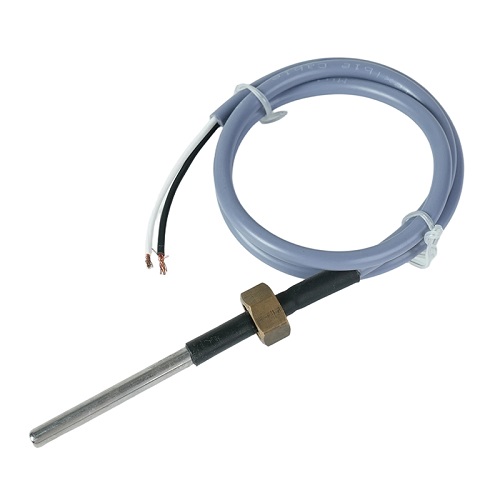
What Is a PT100 Sensor?
A PT100 is a platinum resistance temperature detector (RTD) with a nominal resistance of 100 ohms at 0°C. As temperature changes, the electrical resistance of the platinum element changes in a predictable way, allowing the sensor to measure temperature accurately.
PT100 sensors are widely used in industrial equipment, process control, HVAC systems, machinery, and other applications where stable temperature measurement is required.
What Is a PT1000 Sensor?
A PT1000 is also a platinum RTD sensor, but its nominal resistance is 1000 ohms at 0°C. Because the resistance change is larger compared with PT100, PT1000 can provide a stronger electrical signal for the same temperature change.
PT1000 sensors are commonly used in industrial automation, building systems, laboratory equipment, and temperature monitoring applications.
PT100 vs PT1000: What Is the Difference?
| Feature | PT100 | PT1000 |
|---|---|---|
| Resistance at 0°C | 100 Ω | 1000 Ω |
| Sensor Type | Platinum RTD | Platinum RTD |
| Signal Change | Lower resistance change | Higher resistance change |
| Lead Resistance Effect | More significant | Generally lower relative effect |
| Typical Applications | Industrial process measurement | Automation and temperature monitoring |
How Does Resistance Affect Sensor Selection?
The main electrical difference between PT100 and PT1000 is their nominal resistance. A PT1000 produces a larger resistance change for a given temperature change, which can make the temperature signal easier to detect in some measurement systems.
This characteristic can also help reduce the relative influence of lead resistance, especially when the sensor is installed some distance away from the measuring instrument.
Which Is More Accurate, PT100 or PT1000?
Neither PT100 nor PT1000 is automatically more accurate simply because of its resistance value. Accuracy depends on the RTD element class, sensor construction, wiring method, measuring instrument, installation conditions, and calibration.
For applications requiring higher measurement accuracy, buyers should consider the sensor tolerance class, wiring configuration, transmitter compatibility, and the complete measurement system rather than looking only at PT100 or PT1000.
PT100 or PT1000: Which One Should You Choose?
PT100 may be a suitable choice when the existing control system, PLC, transmitter, or temperature instrument is designed for 100-ohm platinum RTDs. It is also widely used in industrial temperature measurement systems.
PT1000 can be advantageous when a higher resistance signal is preferred or when reducing the relative influence of lead resistance is important. It is also commonly selected for modern automation and electronic temperature measurement systems.
What Factors Should You Consider?
Measuring temperature range: Select an RTD element and construction suitable for the required temperature range.
Accuracy requirements: Check the RTD tolerance class and required measurement accuracy.
Wiring distance: Consider the influence of lead resistance when the sensor is installed far from the instrument.
Wiring configuration: Choose between 2-wire, 3-wire, and 4-wire configurations according to system requirements.
Instrument compatibility: Make sure the PLC, controller, transmitter, or temperature display supports the selected RTD type.
Installation conditions: Consider vibration, moisture, pressure, chemicals, and mechanical requirements.
Response time: Sensor size and construction can affect how quickly the RTD responds to temperature changes.
Custom PT100 and PT1000 RTD sensors
For industrial applications, standard PT100 or PT1000 sensors may not always meet specific installation requirements. RTD sensors can be customized in terms of probe length, diameter, housing material, cable length, connector, thread, wiring configuration, and temperature range.
Custom RTD sensor solutions can help manufacturers and industrial equipment companies integrate temperature measurement into different machines, process systems, and automation equipment.
Conclusion
PT100 and PT1000 are both reliable platinum RTD sensors, but they are designed around different nominal resistance values and system requirements. PT100 is widely used in industrial temperature measurement, while PT1000 can provide a higher resistance signal and lower relative sensitivity to lead resistance.
The right choice should be based on the complete measurement system, including accuracy, wiring distance, instrumentation, installation environment, and application requirements.