



Temperature measurement is a critical part of many industrial,commercial,and scientific applications.Among the most widely used resistance temperature detectors(RTDs)are the pt100 temperature sensor and the PT1000 temperature sensor.Both use platinum sensing elements and provide highly accurate temperature measurements,but they differ in resistance values,signal performance,wiring considerations,and application suitability.
If you're choosing between a PT1000 temperature probe and a PT100 temperature probe,understanding their differences can help you select the best sensor for your project.
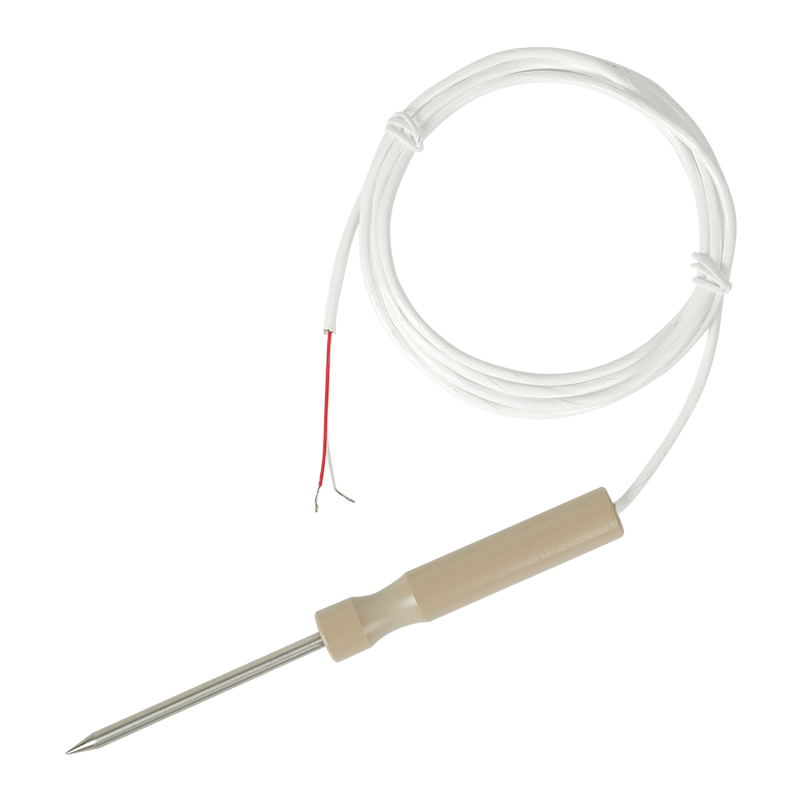
What Are PT100 and PT1000 Temperature Sensors?
Both PT100 and PT1000 temperature sensors are RTD(Resistance Temperature Detector)devices that measure temperature by detecting changes in the electrical resistance of a platinum element.
The key difference lies in their resistance at 0°C:
PT100:100Ωat 0°C
PT1000:1000Ωat 0°C
Both sensors follow the same temperature-resistance relationship and offer excellent measurement stability and repeatability.
How Do PT100 and PT1000 Sensors Work?
Both sensors operate on the same principle:
Rt=R0(1+αT)
As temperature changes,the resistance of the platinum element changes in a predictable way.A controller,transmitter,or measurement instrument reads the resistance value and converts it into a temperature reading.
While the operating principle is identical,the difference in base resistance creates several practical advantages and disadvantages.
PT100 vs PT1000:Key Differences
1.Resistance Value
The most obvious difference is the nominal resistance.
| Sensor Type | Resistance at 0°C |
|---|---|
| PT100 | 100 Ω |
| PT1000 | 1000 Ω |
A PT1000 temperature sensor has ten times the resistance of a PT100 sensor.
2.Signal Strength
Because a PT1000 temperature probe has higher resistance,it generates a larger measurable resistance change for the same temperature variation.
Advantages include:
Stronger signal output
Easier signal processing
Improved measurement stability
This makes PT1000 sensors especially useful in systems with limited signal amplification capability.
3.Cable Resistance Influence
Lead wire resistance can introduce measurement errors.
With a PT100 temperature sensor,even small amounts of cable resistance can affect measurement accuracy.
Because a PT1000 temperature sensor has much higher base resistance,the impact of cable resistance becomes significantly smaller.
For this reason,PT1000 sensors are often preferred for:
Long cable installations
Building automation systems
HVAC monitoring
Remote sensing applications
4.Wiring Requirements
PT100
Often requires:
3-wire configuration
4-wire configuration
These wiring methods compensate for lead wire resistance and improve accuracy.
PT1000
Can often achieve excellent performance using:
2-wire configuration
3-wire configuration
This simplifies installation and reduces wiring costs.
5.Measurement Accuracy
Both PT100 and PT1000 RTD sensors can achieve very high accuracy when manufactured to the same tolerance class.
For example:
Class A PT100
Class A PT1000
Both provide nearly identical temperature accuracy.
The difference is not the sensor element itself but the measurement circuit and wiring conditions.
6.Noise Immunity
The higher resistance of a PT1000 temperature probe typically provides better immunity to electrical noise and interference.
This makes PT1000 sensors particularly useful in:
Industrial automation
Factory environments
HVAC systems
Smart building controls
7.Cost Considerations
Generally:
PT100 sensors are widely standardized in industrial process control.
PT1000 sensors may be slightly more expensive depending on configuration.
However,installation costs may be lower for PT1000 systems because simpler wiring can often be used.
| Feature | PT100 | PT1000 |
|---|---|---|
| Resistance at 0°C | 100 Ω | 1000 Ω |
| Signal Output | Lower | Higher |
| Cable Resistance Influence | Higher | Lower |
| Noise Immunity | Good | Better |
| Wiring Complexity | Moderate | Simpler |
| Long Cable Performance | Good | Excellent |
| Installation Cost | Moderate | Often Lower |
| Industrial Standard Usage | Very Common | Increasingly Popular |
Applications of PT100 Temperature Sensors
A PT100 temperature probe is commonly used in:
Industrial process control
Chemical processing plants
Power generation facilities
Oil and gas applications
Laboratory instrumentation
Its long history and widespread adoption make it a standard choice in many industries.
Applications of PT1000 Temperature Sensors
A PT1000 temperature probe is widely used in:
HVAC systems
Building automation
Refrigeration equipment
Environmental monitoring
Renewable energy systems
Food processing equipment
Its strong signal and reduced sensitivity to cable resistance make it ideal for distributed temperature measurement systems.
Which Sensor Should You Choose?
Choose PT100 If:
Your equipment is designed specifically for PT100 inputs.
You work in traditional industrial process control systems.
You require compatibility with existing instrumentation.
Choose PT1000 If:
Long cable runs are involved.
You need simpler wiring.
Electrical noise is a concern.
You are designing HVAC or building management systems.
You want improved signal strength.
FAQ
Is PT100 more accurate than PT1000?
No.When manufactured to the same accuracy class,both sensors offer very similar measurement accuracy.
Why is PT1000 often preferred for HVAC applications?
Because the higher resistance reduces wiring errors and allows simpler installation over longer distances.
Can a PT100 replace a PT1000 sensor?
No.Their resistance values differ significantly,and measurement equipment must be designed for the correct sensor type.
Which sensor is better for long cable runs?
The PT1000 temperature sensor is generally better because cable resistance has less impact on measurement accuracy.
Are PT100 and PT1000 both RTD sensors?
Yes.Both are platinum-based RTD Temperature Sensors that operate using resistance changes caused by temperature variation.
