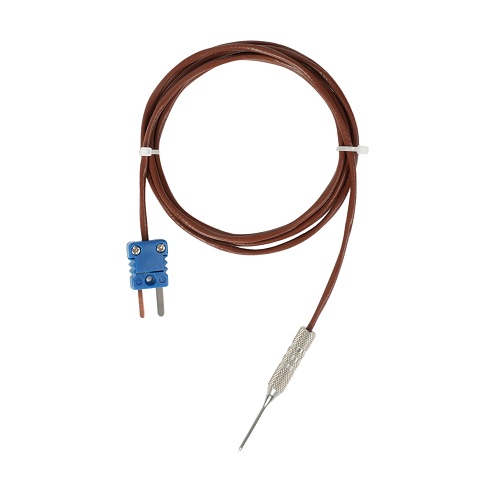
A Type T thermocouple probe is a temperature sensor designed to measure temperature by using the voltage generated between two different metal conductors. Type T thermocouples are typically made from copper and constantan, making them particularly suitable for low-temperature measurement and applications that require stable and reliable temperature readings.
Due to their good measurement stability and sensitivity at lower temperatures, Type T Thermocouple Probes are commonly used in food processing, laboratory testing, refrigeration, HVAC systems, environmental monitoring, and other temperature-sensitive applications.
What Materials Are Used in a Type T Thermocouple?
A Type T thermocouple consists of two different metal wires:
Copper: Used as the positive conductor.
Constantan: Used as the negative conductor.
When these two conductors are joined at the measuring end, a thermoelectric voltage is generated when there is a temperature difference between the measuring junction and the reference junction. The sensor or measuring instrument converts this voltage into a temperature reading.
The probe may also include a protective metal sheath, insulation materials, connection wires, and a terminal or connector. The specific materials and structure can be customized according to the application requirements.
How Does a Type T thermocouple probe Work?
The working principle of a Type T thermocouple probe is based on the Seebeck effect. This effect describes the generation of a voltage when two different conductive materials experience a temperature difference.
1. Temperature Difference Generates a Voltage
The copper and constantan wires are joined together at the sensing tip. When the sensing tip is exposed to a different temperature from the reference point, a small electrical voltage is generated between the two conductors.
2. The Thermocouple Produces a Temperature-Related Signal
The generated voltage changes according to the temperature difference. Because the relationship between thermoelectric voltage and temperature is known, the signal can be used to determine the temperature at the measuring junction.
3. The Measuring Instrument Processes the Signal
A temperature controller, thermometer, data logger, or other compatible instrument reads the thermoelectric signal. The instrument uses the relevant thermocouple calibration data and reference-junction compensation to calculate the measured temperature.
4. The Temperature Is Displayed or Recorded
After processing the signal, the instrument displays or records the temperature. In industrial systems, the measurement can also be used to control heating, cooling, refrigeration, or other temperature-related processes.
What Are the Advantages of a Type T Thermocouple Probe?
Reliable Low-Temperature Measurement
Type T thermocouples are well suited to many low-temperature applications. They are often selected for monitoring chilled products, refrigerated environments, laboratory samples, and other temperature-sensitive materials.
Good Measurement Stability
The copper-constantan combination offers useful thermoelectric characteristics for applications requiring consistent temperature monitoring. Proper probe construction and calibration can further support measurement reliability.
Fast Temperature Response
Depending on the probe diameter, sheath design, sensing junction, and installation conditions, a Type T thermocouple probe can provide a fast response to temperature changes.
Flexible Probe Configurations
Type T thermocouple probes can be manufactured in different lengths, diameters, sheath materials, cable types, and connector configurations. This makes them suitable for a wide range of equipment and installation environments.
Easy Integration
Type T thermocouple probes can be connected to compatible thermometers, temperature controllers, data acquisition systems, and industrial monitoring equipment.
Where Are Type T Thermocouple Probes Used?
Food Processing: Monitoring food, beverages, refrigeration, and cold-chain conditions.
Laboratory Testing: Measuring the temperature of samples, test chambers, and experimental equipment.
HVAC Systems: Monitoring air, pipes, cooling systems, and temperature-controlled environments.
Refrigeration: Measuring temperatures in cold storage, freezers, and refrigerated equipment.
Environmental Monitoring: Measuring temperatures in controlled environments and testing facilities.
Industrial Equipment: Monitoring temperature in machinery and processes that operate within the suitable range of a Type T thermocouple.
What Should You Consider When Using a Type T Thermocouple Probe?
Although Type T thermocouples are suitable for many low-temperature applications, the probe should be selected according to the actual operating conditions. Important factors include the required temperature range, probe dimensions, sheath material, response time, cable insulation, connection type, and measurement environment.
It is also important to use a compatible measuring instrument and ensure that the thermocouple type is correctly configured. Proper installation and calibration can help reduce measurement errors.
Can Type T Thermocouple Probes Be Customized?
Yes. Manufacturers can provide customized Type T thermocouple probes for different equipment and temperature measurement requirements. Customization options may include:
Probe length and diameter
Sheath material and protective tube design
Grounded, ungrounded, or exposed junctions
Cable length and insulation material
Connector and terminal types
Mounting threads and installation accessories
Special probe shapes and application-specific structures
When sourcing a Type T thermocouple probe, working with an experienced manufacturer can help ensure that the sensor structure, materials, and electrical specifications match the requirements of the target application.
A Type T thermocouple probe uses the Seebeck effect to convert a temperature difference into a measurable electrical signal. Made from copper and constantan, it is widely used for low-temperature measurement in food processing, laboratories, refrigeration, HVAC systems, and other temperature-sensitive applications.
By selecting the appropriate probe structure, materials, dimensions, and connection method, users can achieve reliable temperature monitoring for different equipment and operating conditions.
Looking for a Type T thermocouple probe for your application? Contact us to discuss your temperature range, probe dimensions, cable requirements, and customization needs.